How to Live With Large-Scale Art — A Collector's Guide to Going Big
There is a moment that every collector knows. The moment a large painting arrives and the room reorganizes itself around it. The furniture that felt permanent suddenly looks movable. The wall you thought was just a wall reveals itself to have been waiting for something. The proportions of the entire space shift.
Living with large-scale art is one of the most rewarding decisions you can make as a collector and as someone who cares about the quality of the spaces they inhabit. It is also, if approached without intention, one of the easiest ways to get it wrong. A great painting placed badly is still a great painting , but it is not being allowed to do its full work.
This guide is for anyone ready to commit: to a piece, to a wall, to a way of living that takes art seriously as architecture, as atmosphere, as daily companion.
Why Scale Changes Everything

Small and medium art can be arranged. Large-scale art must be reckoned with.
This is not a criticism — it is the entire point. A painting that commands a wall forces you to make decisions: about furniture placement, about lighting, about what else shares the room with it. It demands that you become intentional about your space in ways that a well-arranged gallery wall never will.
The psychological effect of a large painting is also qualitatively different from that of a smaller work. Art critic Peter Frank, writing about Haleh Mashian's large-scale Tree Series canvases, described the experience as like "walking into a multicolored forest". That immersive quality, that sense of being inside a work rather than merely looking at it, is only available at scale. The painting stops being an object in the room and starts being part of the room's atmosphere.
That is the goal. That is what you are working toward.
Choosing the Right Large-Scale Work for Your Space
Before you think about walls or lighting, think about why you are drawn to large-scale art in the first place. The answer will guide everything else.
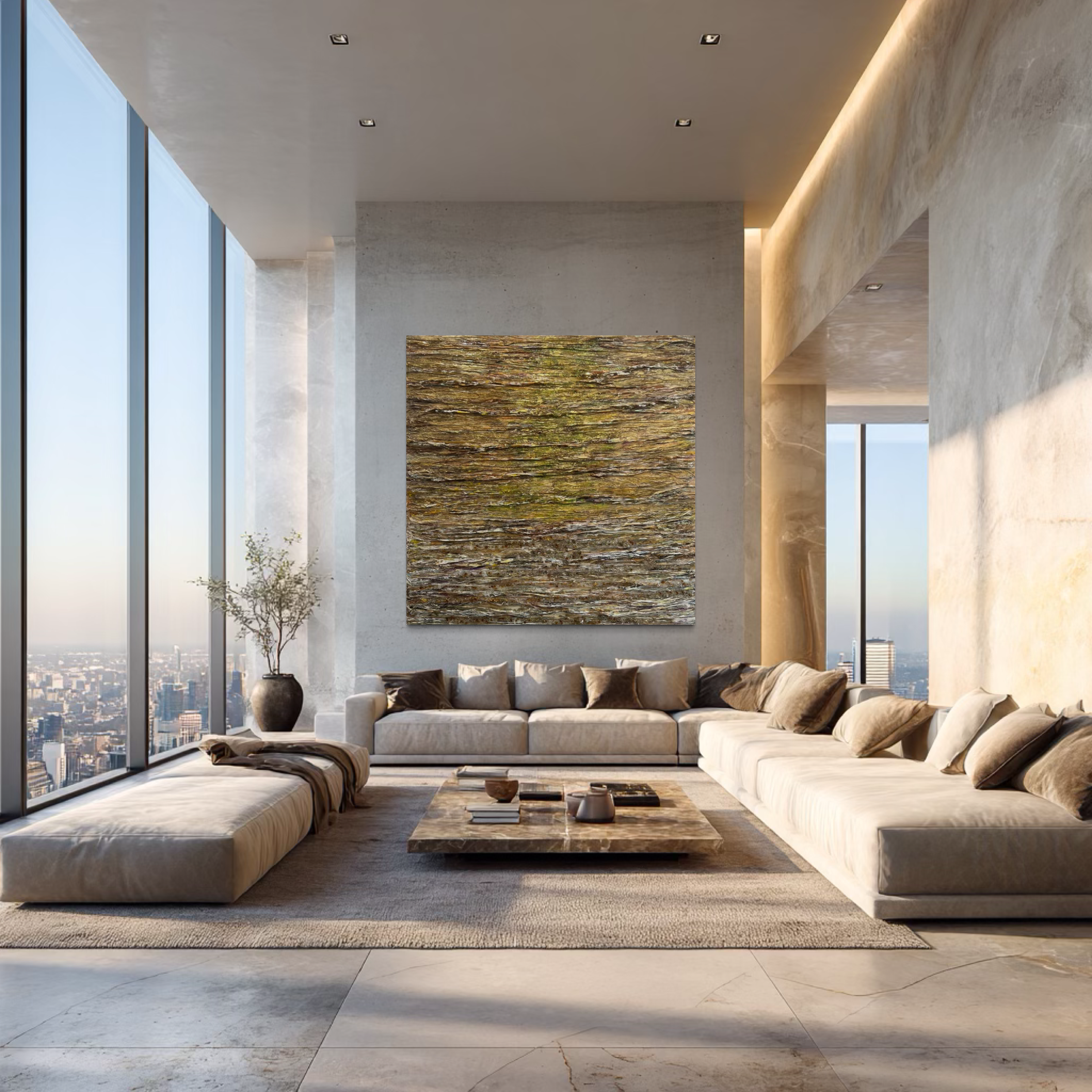
If you want presence without aggression, a work that fills the room with energy but doesn't dominate conversation, look to paintings whose scale comes from expansiveness rather than intensity. Mashian's Tree Series operates this way. These large canvases, built from layered impasto and mixed media on wood panel, create what feels less like a painting and more like a window into a living landscape. Works like Spring Symphony carry enormous visual weight while remaining meditative — they breathe with the room rather than demanding attention from it. Mashian paints not trees themselves but, as Frank describes it, "the condition that persists between trees and forests" — an emotional and psychological weather that fills a large wall without ever feeling heavy.

Spring Symphony by Haleh Mashian
If you want your art to be the emotional center of the room — the first thing guests feel when they walk in — look for work with concentrated chromatic and psychological power. Mashian's Water Series does this with extraordinary authority. Paintings like At Your Shore and Golden Hour II channel the full physical force of the ocean: the surge and retreat, the shimmer and depth, the quality of water as something that simultaneously calms and commands. Mashian describes these works as a "flotation journey to a state of creative release" and at large scale, that release is palpable. These paintings don't hang so much as they move.

Golden Hour II by Haleh Mashian
If you want a large-scale work that is deeply personal and brings a living human presence into the space, Mashian's Figurative Series offers some of her most commanding large-format work. Described as "an homage to the dichotomies of what it means to be feminine: soft and bold, fluid and stalwart, vulnerable and invincible," these paintings introduce a presence that is felt throughout a room. Works like A Quiet Moment, Disintegrated, and The Future is Now each have the quality of a figure that has just walked into the space and chosen to stay.

The Future is Now by Haleh Mashian
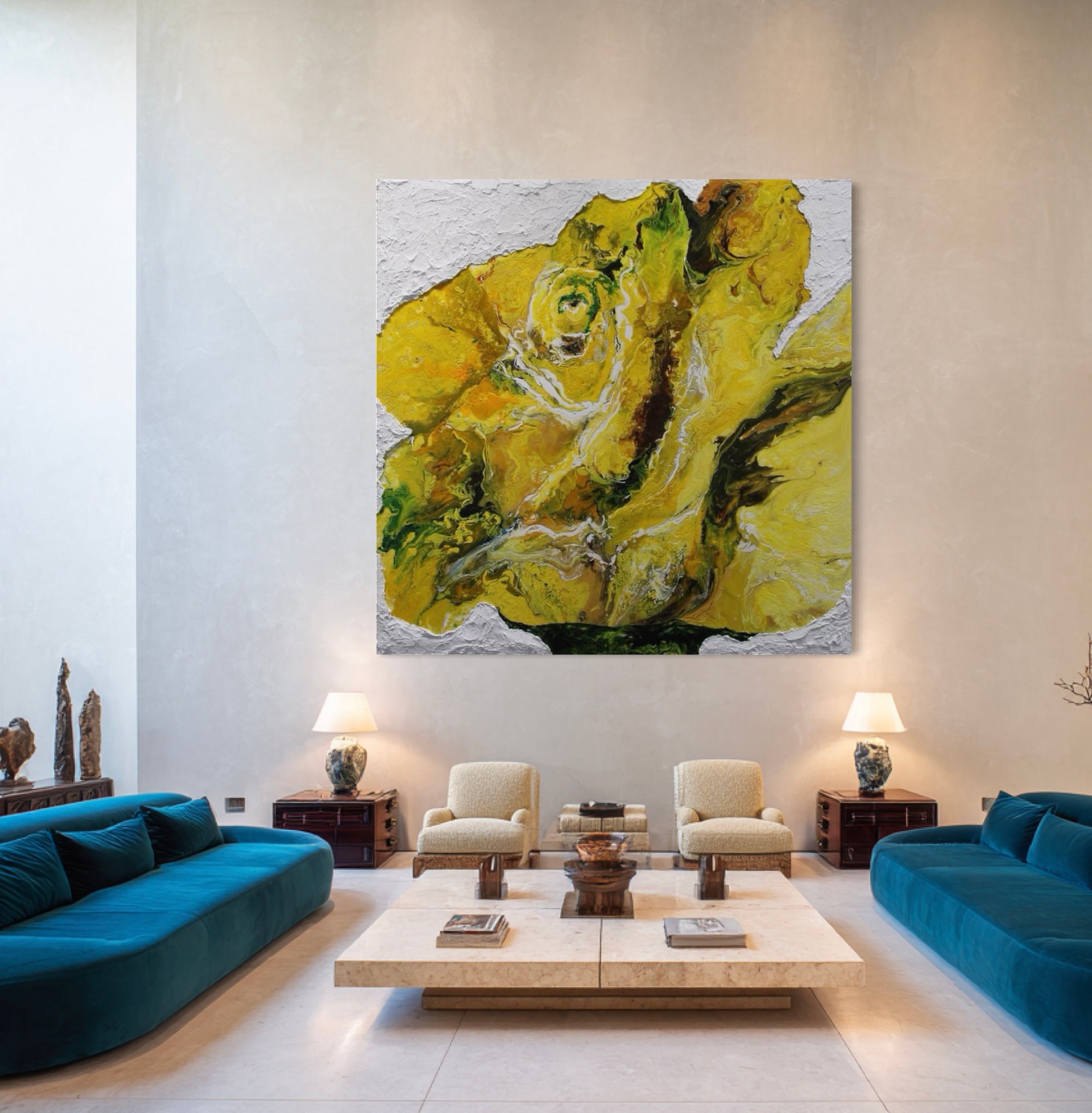
If you want drama and lushness in equal measure, look to Mashian's Rose Series. These large-scale, mixed-media paintings on wood panel are not gentle interpretations of the rose — they are confrontations with it. Evocative and startling rather than delicate, they bring a concentrated, almost theatrical beauty to a wall. A large Rose Series painting above a fireplace or anchoring a dining room produces the kind of immediate, visceral response that collectors return to again and again.

Morning Glory by Haleh Mashian
The Wall: How to Choose It
Not all walls are equal candidates for large-scale art, and part of living well with a big painting is placing it where it can perform at its best.
The anchor wall, the wall you face when you enter a room, or the wall your seating arrangement naturally orients toward, is the most powerful position in any space. A large painting here becomes the room's thesis statement. Everything else exists in relation to it. This is where a commanding Water Series or Figurative piece belongs: somewhere you will meet it every time you enter, and every time it will be slightly different.
The long wall in a hallway or corridor is one of the most underused opportunities in residential design. A large horizontal canvas from the Tree Series transforms a transitional space into a destination. You stop walking. You look into the forest. The mundane act of moving through your home becomes an experience.

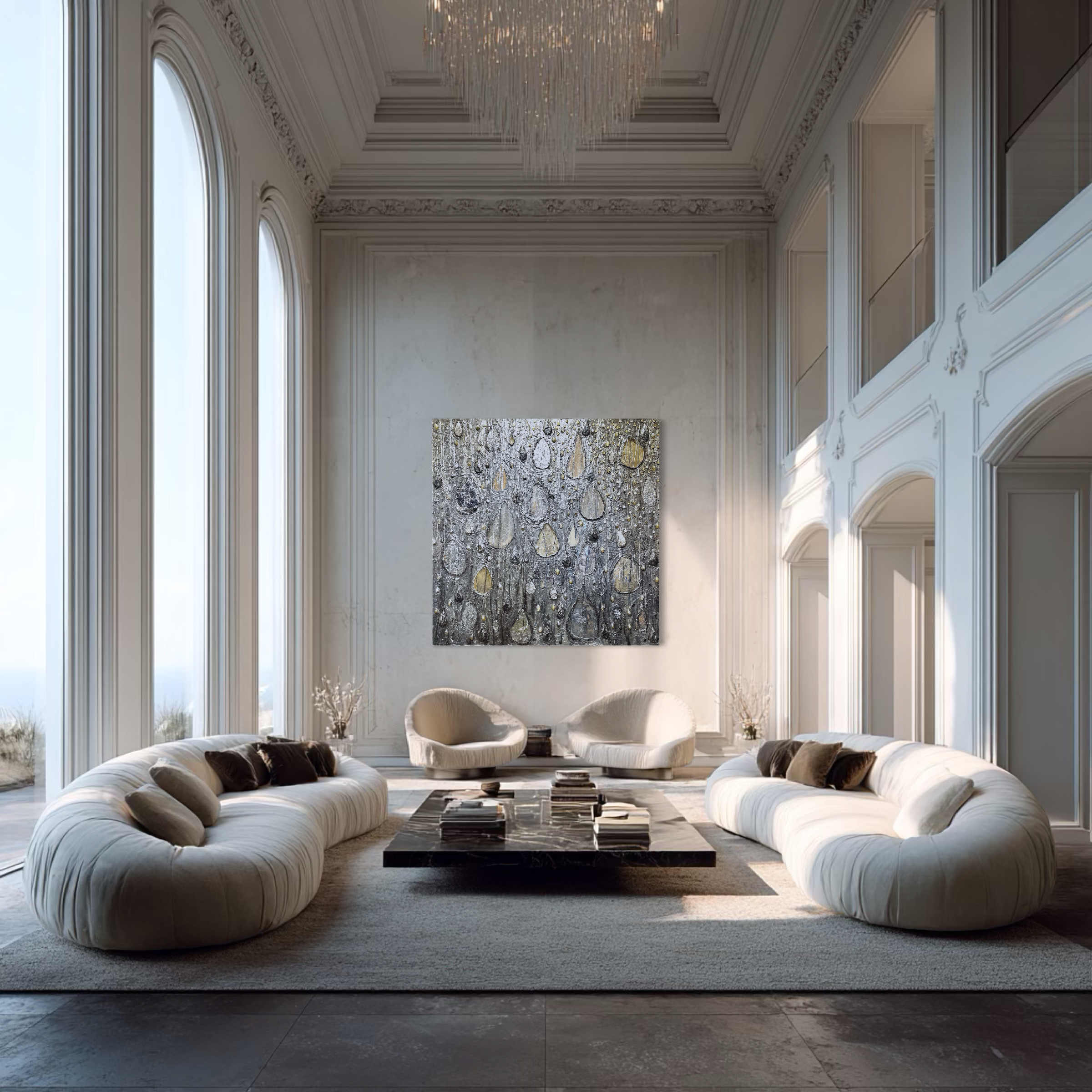
Jeweled Black Tears by Haleh Mashian
Above a fireplace works beautifully for large art — but only when proportions are right. The painting should be slightly narrower than the mantel width, with 4–6 inches of breathing room between the bottom of the frame and the mantel surface. A large Water Series painting works particularly well here: the scale of the work against the architecture creates a dramatic, almost theatrical focal point.
What to avoid: placing a large painting in a room where the viewing distance is insufficient. The general principle is that you should be able to step back to a distance of at least 1.5 times the painting's longest dimension. If the room doesn't allow for that, the painting is too large for the space or the furniture arrangement needs to change to create the distance.
Hanging: The Non-Negotiable Details
Large paintings are not hung the same way small paintings are. The stakes are higher, and small mistakes are visible from across the room.
Eye level means eye level. The center of the painting should sit at approximately 57–60 inches from the floor, the standard museum hang height, corresponding to average standing eye level. The most common mistake with large paintings is hanging them too high, driven by the instinct to get a big object "up and out of the way." Resist it. A painting at proper eye level feels like it belongs in the room; hung too high, it floats — disconnected from the space and from you.
Hardware matters enormously. A large mixed-media painting on wood panel, the kind of scale Mashian's work regularly reaches, can weigh significantly more than you expect. Before anything goes on the wall, locate your studs and use hardware rated for the actual weight of the piece. If you're uncertain, consult a professional art installer. The cost is trivial compared to the alternative.
Lean it first. Before committing to nail holes, lean the painting against the wall and live with it for a few days. Move it. Try different positions. Let your eye adjust. You will almost always discover that the first wall you chose was right — but you'll know it with certainty, which changes everything about how you inhabit the space with it.
Lighting Large-Scale Art: The Detail That Makes or Breaks Everything

Silver Trickle I by Haleh Mashian
Unlit or poorly lit, even the greatest painting retreats into the wall. Properly lit, it becomes the room's most alive surface.
For large-scale paintings with dimensional, sculptural surfaces, the direction of light matters as much as its intensity. Raking light from the side catches every ridge of paint and makes the texture visible and dramatic. Flat, overhead light flattens the surface and kills the dimensionality that makes these works extraordinary up close.
Picture lights mounted directly above the painting create focused illumination without spilling into the rest of the room. For large works, two picture lights provide more even coverage than one across the full width of the canvas.
Adjustable track lighting gives maximum flexibility. Position fixtures so the beam creates that slight side-rake, and use bulbs with a high color rendering index (CRI 90+) so the painting's colors read as the artist intended. Warm white (2700–3000K) flatters the rich, layered palettes of the Water and Rose Series; neutral white (3500–4000K) works well for the cooler, more atmospheric compositions in the Tree Series.
Natural light is beautiful but requires management. Direct sunlight on original paintings, particularly mixed-media work with resin or delicate surface materials, can cause fading over time. If your primary wall receives direct sun for several hours a day, UV-filtering window film is a sound investment, or consider positioning the painting where it receives indirect, diffused natural light rather than direct exposure.
Living With It: The Art of Daily Relationship
Here is what no one tells you about large-scale art: it changes.
Not the painting itself — though the way light moves across it through the seasons will reveal things you have never noticed. What changes is your relationship to it. In the first week you live with a large painting, you see it. By the third month, you feel it. By the second year, it has become so woven into your experience of your home that walking into the room without it would feel like something was missing — something you couldn't quite name but would immediately sense.
This is the deepest argument for original large-scale work over prints, reproductions, or decorative art. A handmade painting carries accumulating presence in a way that a reproduction never can. It was made in a specific moment, by a specific person, with accumulated craft and genuine feeling. That origin is legible — not consciously, perhaps, but it registers. The room knows.
Mashian's large canvases are built for this kind of long relationship. The layered materiality of her work — the collage, the impasto, the dimensional surfaces that reward sustained and repeated looking — means there is always something new to notice. A shift in afternoon light makes the Tree Series glow in colors you hadn't seen before. A quiet evening in front of a Water Series painting produces a different kind of looking than a bright Saturday morning does. The Figurative Series feels different when you are alone than when the room is full of people. The work meets you where you are, each time, differently.

Whirling Vortex by Haleh Mashian
That is not decoration. That is what it means to live with art.
Where to Begin
If you are ready to bring a large-scale original painting into your home, the best starting point is always the space itself. Measure your walls. Consider the light. Think about which room you want to transform — the one you walk into first, the one you spend the most time in, the one that has always felt like it was missing something.
Then let the work choose you.
Haleh Mashian's large-scale paintings span four primary series — the Tree Series, the Water Series, the Rose Series, and the Figurative Series — each offering a different emotional register and visual language. All are available for acquisition and private viewing, with guidance available on sizing, placement, and commission options for custom scale.
Haleh Mashian is a Los Angeles-based contemporary artist working in mixed media, large-scale painting, and sculptural abstraction. Her work is held in private and corporate collections across the United States and internationally. Original paintings are available through her studio, at halehmashian.com, and through Mash Gallery in West Hollywood.
Tags: large scale art, large paintings for home, how to hang oversized art, large abstract paintings, contemporary art collector tips, original paintings Los Angeles, Tree Series, Water Series, Figurative Series, Rose Series, Haleh Mashian, large wall art, art installation tips, art collector guide, mixed media paintings, abstract expressionism