What Are the 5 C's of Evaluating Art?

What Are the 5 C's of Evaluating Art?
Walking into a gallery, you might feel it immediately: a painting that stops you, something that pulls you closer before you even know why. But once the initial response settles, how do you move from feeling to understanding? How do you begin to articulate what makes a work compelling, significant, or worth collecting?
As both an artist and the founder of MASH Gallery, I work with collectors at every level of experience, and one of the most common questions I hear is: how do you actually evaluate a work of art? There are frameworks that critics, curators, and seasoned collectors use, and one of the most accessible is built around five essential concepts. Think of them as lenses, each one bringing a different layer of the work into focus. Together, they form a complete picture.

Concept
Every work of art begins with an idea. The concept is the animating force behind the piece: what the artist was thinking, feeling, or asking when they made it. It doesn't have to be a thesis statement or a manifesto. Often, the most powerful concepts are simple ones explored with depth and rigor. A recurring motif across a body of work, a meditation on transformation, an investigation into memory or nature or the body: these are all concepts.
When evaluating a work, ask yourself what question the artist seems to be sitting with. Is there an internal logic to the decisions made? Does the title, the scale, the material choice all point toward the same idea, or do they feel arbitrary? A strong concept doesn't explain the work away; it opens it up. It invites you to keep looking.
In my own practice, concept is always the starting point. Whether I'm working on a piece from my Butterfly Series or a large-scale Water painting, the idea comes first. Everything else is in service of it.

Composition
Composition is how the artist organizes the visual space. It governs where your eye moves, what it rests on, what feels balanced or deliberately unbalanced. In painting, this includes the relationship between shapes, the use of positive and negative space, the placement of color fields, the rhythm of marks. In sculpture, it's about how form occupies three-dimensional space and how the work changes as you move around it.
A strong composition creates tension and resolution simultaneously. It holds you inside the frame. You feel the pull of one corner against the weight of another, and the whole thing stays in equilibrium even when it looks like it shouldn't. Weak composition tends to produce a kind of visual restlessness: your eye drifts out of the frame without satisfaction.
Studying composition is one of the most transferable skills in art evaluation. Once you train your eye to see how a work is organized, you start to notice it everywhere.

Craft
Craft is the technical dimension: the skill, precision, and mastery brought to the execution. It varies enormously by medium, and evaluating craft means understanding what each medium demands and whether the artist has met that demand on their own terms.
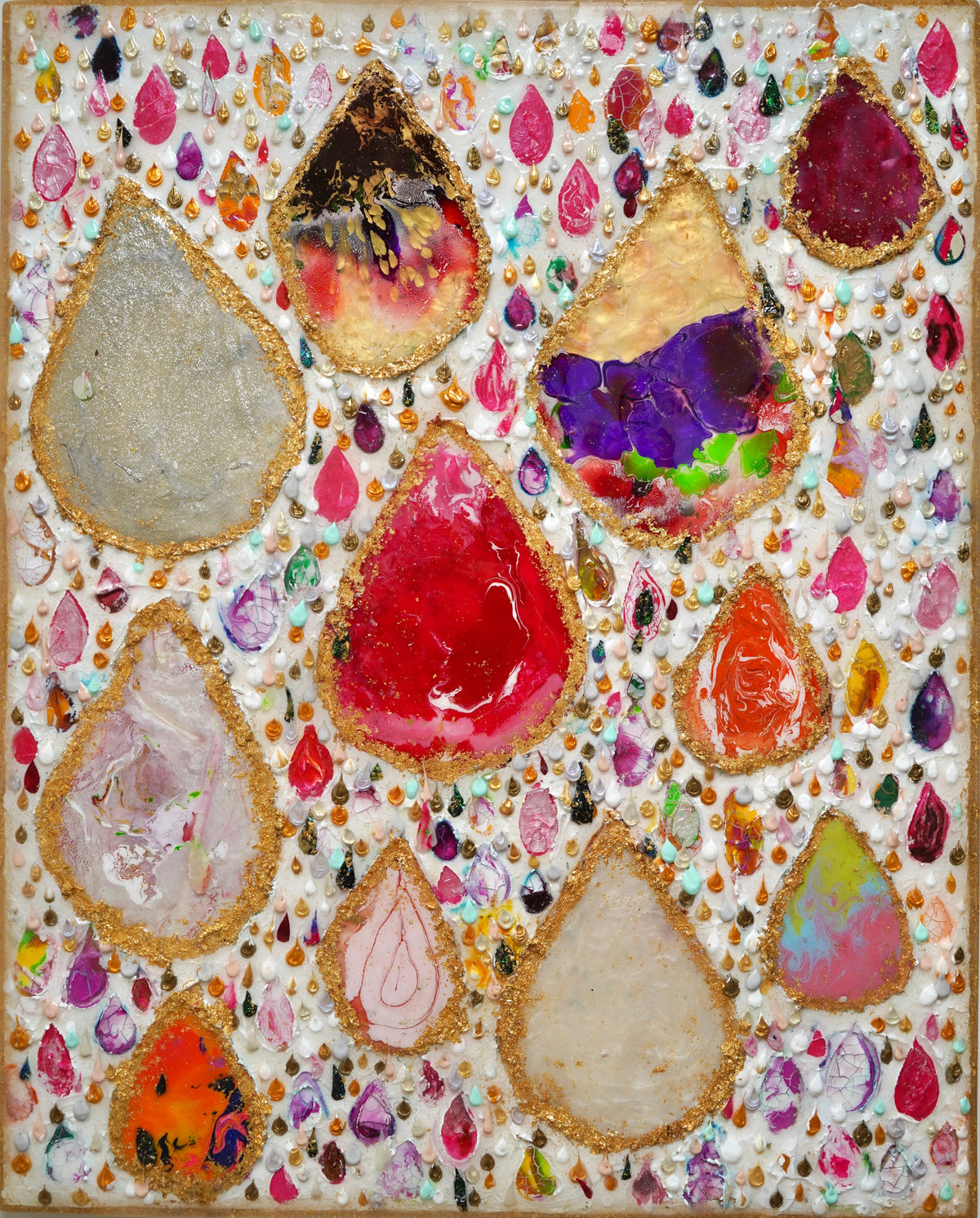
In painting, craft includes how paint is applied, the quality of edges, the handling of texture, the internal consistency of the surface. In mixed media work, it includes how disparate materials are unified and whether they hold together physically and visually over time. I work extensively with impasto, resin, and gold leaf, and the decisions made at the material level are never incidental. They're structural to the meaning of the piece.
Craft isn't about polish or conventional technique. Many of the most important artists in history worked in ways that looked rough or unfinished by academic standards. What matters is whether the technical choices serve the work. Is there evidence of genuine skill being deployed, even if that skill is the skill of knowing when to stop? Or does the execution feel accidental, underworked, or simply not up to the ambition of the concept?

Context
No work of art exists in isolation. Context is the layer of meaning that comes from understanding where a work sits: in the artist's biography, in art history, in the culture from which it emerged, and in the moment it was made.
Context doesn't determine meaning, but it deepens it. Knowing that an artist was grappling with displacement, or working in response to a specific movement, or returning to a subject after a decade away, changes how you encounter the work. It adds weight and resonance without diminishing what you experienced before you knew any of it.
Context is also relevant to a collector's understanding of an artist's trajectory. Is this work from a pivotal period? Does it represent the emergence of a new direction? Is it in conversation with other significant works? These questions don't answer themselves, but asking them is part of what separates an informed reading from a purely intuitive one.

Conviction
The last C is perhaps the hardest to define and the most important. Conviction is the quality in a work that communicates genuine necessity: the sense that this particular artist needed to make this particular thing. It's what separates work that is technically accomplished and conceptually coherent from work that is actually alive.
You feel conviction as a kind of pressure. The work doesn't hedge. It commits fully to its premise, its material, its point of view. Even if the subject matter is quiet or restrained, there's a completeness to it, an internal authority that resists being dismissed. Works with conviction tend to stay with you. You think about them later. You want to return to them.
For me, conviction isn't something you manufacture. It comes from making work that is genuinely connected to who you are. That's the standard I hold myself to, and it's what I look for when I'm considering new artists for the gallery.

Putting the 5 C's Together
These five concepts work together, not in sequence. A work can have extraordinary craft and no concept. It can have a powerful concept and no conviction. The most enduring works tend to score across all five, but the framework is most useful not as a checklist but as a set of questions that slow you down and teach you to see.
The next time you stand in front of a work that moves you, try naming what's happening. Is it the composition? The concept? The undeniable conviction behind every mark? You might find that what felt like a purely emotional response was actually something more: a recognition, a meeting of minds across the space between you and the wall.
That is what art is for.
Haleh Mashian is a Los Angeles-based contemporary artist and the founder of MASH Gallery in West Hollywood. To explore her current work, visit halehmashian.com.